Where exactly is HADES situated
Located in the Boom Clay
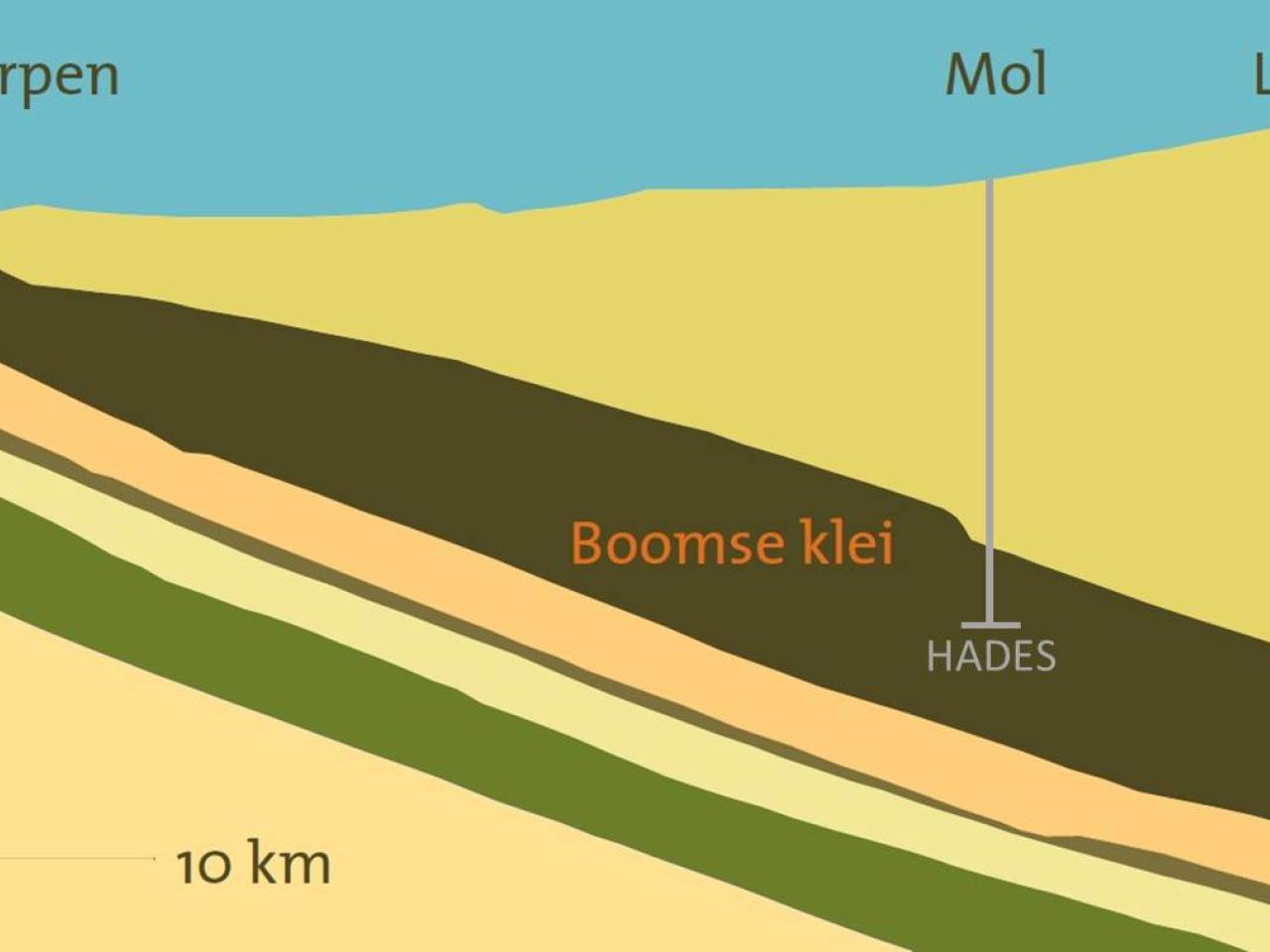
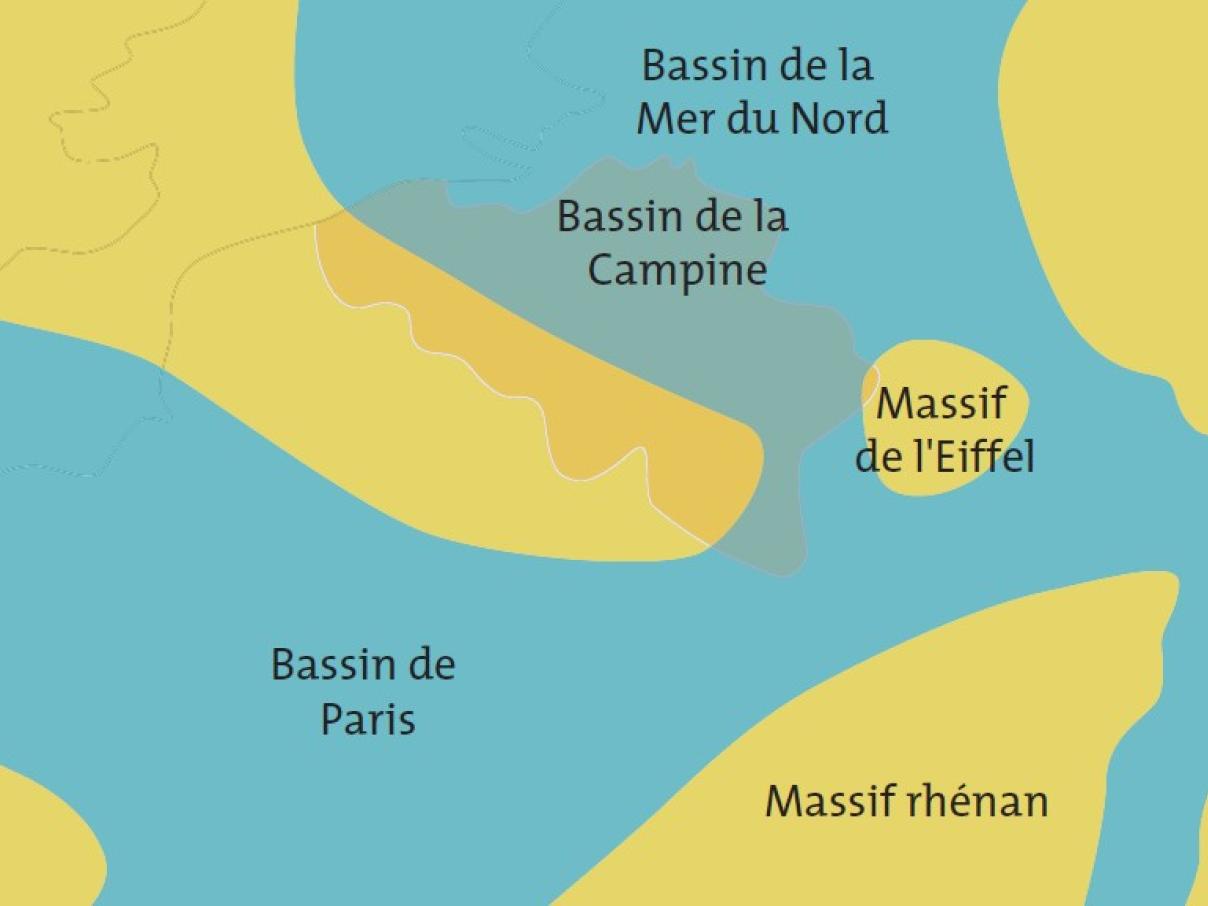
HADES is located at 225 m depth in an argillaceous formation called the Boom Clay. It is - in geological terms - a relatively young sediment that was deposited in an open shelf sea under warm climatic conditions, about 29,3 to 32 million years ago. The map shows what Western Europe looked like 30 million years ago. The yellow parts represent land and the blue parts are water. Note that at that time large parts of Belgium were under water. In this sea, the Boom Clay was deposited layer by layer, as a sediment. The Boom Clay at the location of the HADES lab in Mol has a thickness of 100 meters, between 190 and 290 meters deep. Overall, the clay is quite uniform in terms of its granulometry and mineralogical composition, although it exhibits a very typical layering, as a result of variations in grain size, organic matter content, and carbonate content.
Geologists, studying the evolution of the Earth and the subsoil over a time span of hundreds of thousands and millions of years, evaluate the processes that could have an influence on the stability of the Boom Clay. These processes can be earthquakes or ice caps during future ice ages, but also sea level rises, uplift or erosion or human intrusion. Based on the knowledge of the past, they make an estimate of what we can expect in the future. There are no indications of any thorough disruptions in the next one million years.
LLeeaarrnn mmoorree aabboouutt tthhee ccoonnssttrruuccttiioonn ooff HHAADDEESS
Why Clay?
Clay or argillaceous formations are one of the three options for deep disposal of radioactive waste. Other possible formations are salt and granite. In Belgium, we have a variety of argillaceous formations.
Clay has three important properties making it suitable for deep disposal. The videoclip gives a nice overview of these characteristics.
- Clay is plastic. Thanks to its plastic nature and the high pressure at that depth, any cracks and fissures that appear during the excavation are soon closed again. We call this the ‘self-sealing’ behaviour of the clay.
- Clay lets very little water through. This is a very important property, because water can spread radioactive substances in the subsoil and the groundwater. The water that is present in the clay hardly moves. Therefore, water cannot make the substances spread quickly through the clay.
- For the third property we need to zoom in on the clay minerals. Positively charged radioactive elements adhere to these clay minerals. This adherence takes place at a scale that is 1 000 times smaller than what we can see with the naked eye.
What other host rocks are there?
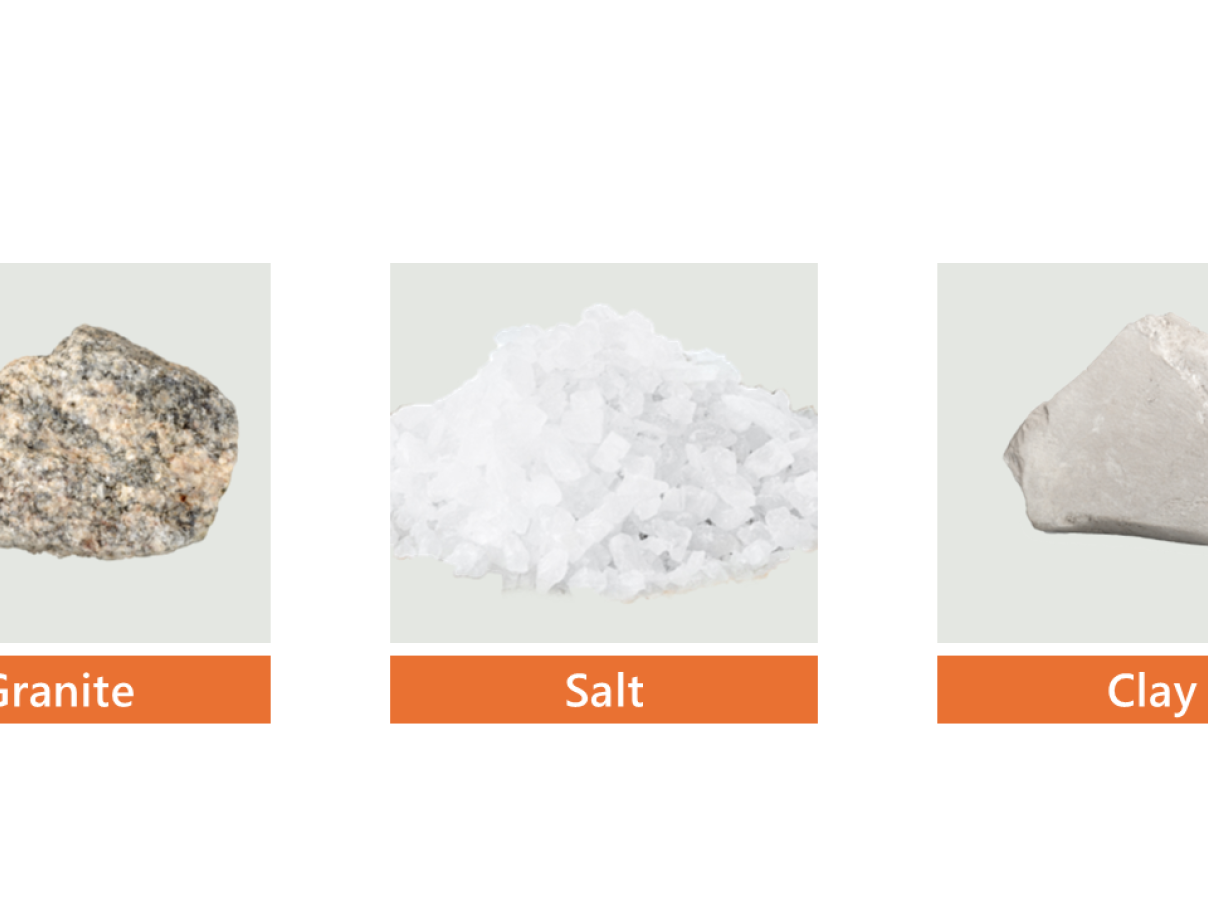
Globally, there are 3 types of rock that qualify for geological disposal: salt, granite and clay.
In Belgium, we focus on clay, or better yet on argillaceous formations. These include clay, claystone and slates, which can be found at various locations. Why don't we consider salt or granite?
- Salt is not an option because there is hardly any salt in Belgium.
- Granite would be possible in theory, but is found at far too great a depth to be technically and economically feasible.
Other countries do focus on salt and granite.