
Why do we need HADES?
When it comes to disposing of radioactive waste safely for hundreds of thousands to millions of years, only geological formations offer the stability required. Human-made structures, no matter how advanced, degrade over time due to corrosion, weathering, and unforeseen environmental changes. Surface-based solutions are vulnerable to climate shifts, erosion, and societal disruptions. In contrast, deep geological formations have remained virtually unchanged for tens of millions of years, shielded from surface processes and natural disasters. Their predictable physical and chemical properties allow scientists to model long-term behaviour with confidence. This is why, worldwide, deep geological disposal has been recognized as the most reliable and final solution for managing high-level radioactive waste, providing passive safety without the need for human intervention over geological timescales.
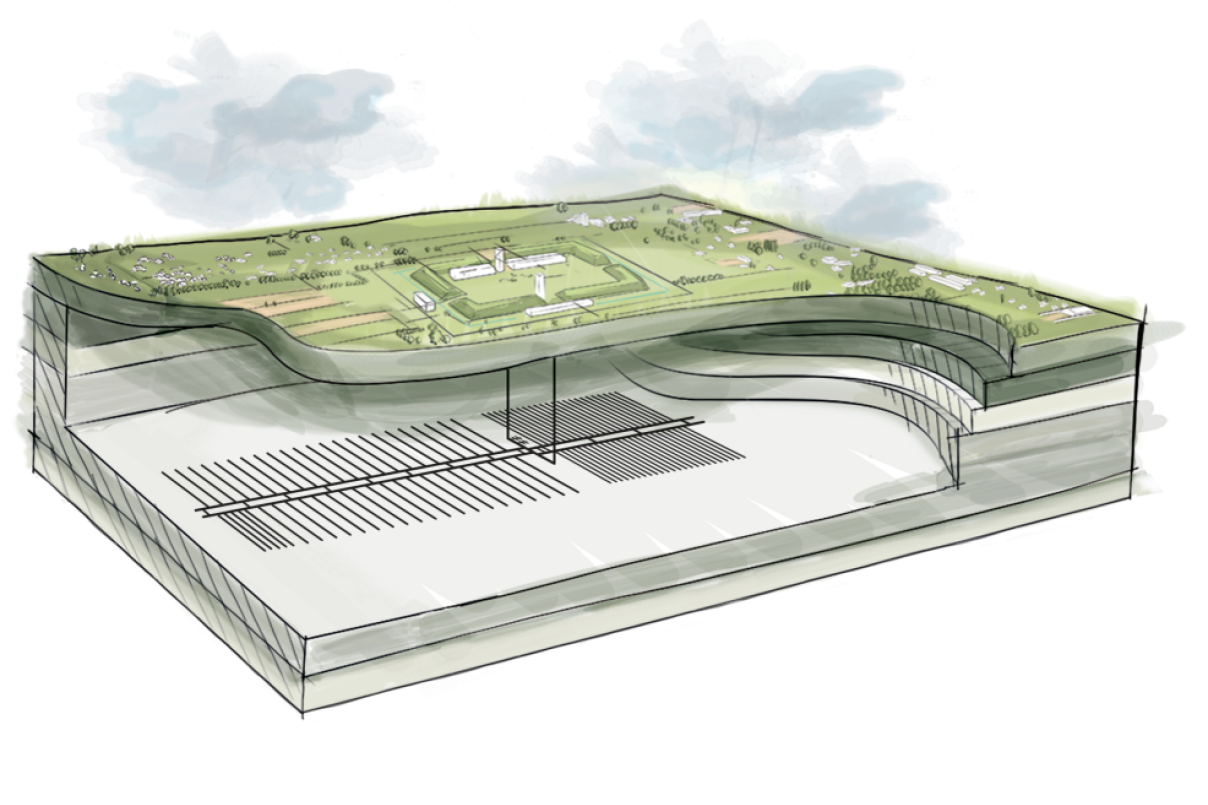
The HADES underground research lab provides the opportunity to study the safety of a deep disposal system under realistic conditions and to demonstrate its technical feasibility. This makes it possible to acquire the expertise needed to develop a waste repository that meets all the safety requirements. The extension of the HADES lab with a second shaft, the connecting gallery and the perpendicular disposal gallery, indeed demonstrated that it is feasible to construct the important elements necessary that make up a deep disposal facility in the current Belgian reference concept.
Belgian research programme on radioactive waste management
HADES, managed by EURIDICE, is of crucial importance to the Belgian research programme on radioactive waste management. This programme is carried out by NIRAS-ONDRAF, in collaboration with the SCK CEN under the umbrella of a public-public partnership. Other partners such as Belgoprocess, Tractebel, Fanc and its technical support organization BelV are key contributors in this Belgian programme. The know-how that was built by the EURIDICE team aswell as during the construction of HADES is also relevant to other aspects of radioactive waste management. Indeed, the instrumentation and monitoring expertise is also very important in the NIRAS-ONDRAF surface repository site in Dessel, where low and intermediate-level, short-lived waste will be disposed of.
Current concept
The current concept for deep disposal of high-level and/or long-lived radioactive waste is to construct a geological disposal facility in poorly indurated clay at a reference depth between 200 and 600 meters. This facility will include a multi-barrier system, that will fully contain the highly active, heat emitting waste during the thermal phase (the period of a few thousand years when that waste is still emitting heat).
In HADES, we study this type of host rock and evaluate the possible perturbations of the clay on a large scale in in situ conditions.
Belgian policy
With its royal decree of 2022, the federal government laid the first important legal foundations for the deep disposal of high-level and/or long-lived radioactive waste. However, many steps still need to be taken before a deep disposal facility can be built as to date, no host rock or location has been chosen yet.
NNIIRRAASS--OONNDDRRAAFF eexxppllaaiinnss BBeellggiiaann ppoolliiccyy
Are there other underground research laboratories in Europe? At which depths and in which host rocks are they located? Learn more here.
What about the Belgian radioactive waste?
The EURIDICE communication department produced a movie to explain the status of the Belgian radioactive waste in 2019. Important milestones for have been reached since then:
- in October 2022, a royal decree was issued stating that deep disposal is the preferred solution for the Belgian high-level and/or long-lived radioactive waste. This decree included a call to action to shape the decision-making process in collaboration with the general public.
- in September 2025, the construction of the NIRAS/ONDRAF surface disposal site for the final disposal of low and intermediate-level, short-lived waste was officially launched.