
Geology of the Boom Clay
Boom Clay has long captured the interest of geologists, engineers, and industry. Its story begins in the 19th century, when fossils from outcrops along the Rupel River served as a reference for the Middle Oligocene. Over time, advances in analytical techniques deepened our understanding of its sedimentology and mineralogy. A major turning point came in 1975, when Boom Clay was first explored as a potential host rock for the geological disposal of high-level nuclear waste. This sparked extensive research and drilling in the Campine subsurface, far beyond its original outcrop area.
Today, Boom Clay’s geology is studied in detail—from its deposition history to its physical, chemical, and diagenetic properties—providing the foundation for understanding its geochemical, hydrogeological, and engineering behavior. This knowledge is crucial for applications ranging from nuclear waste disposal to construction projects in Antwerp’s harbor, where engineers rely on its geomechanical characteristics for tunnels, foundations, and underground storage.
Formation and occurrence
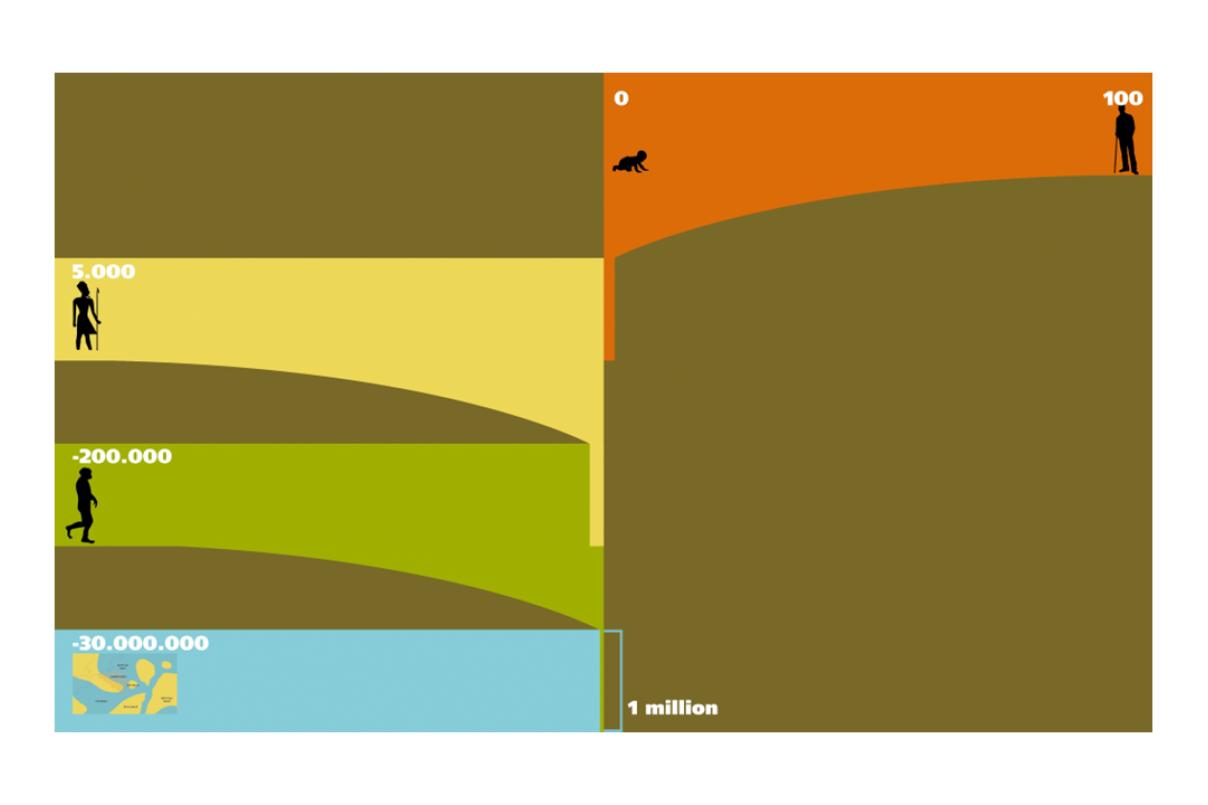
The HADES underground research laboratory is located in the Boom Clay, a geological formation thick layer of clay deposited about 30 million years ago during the Early Oligocene (Rupelian). This clay formed at the southern edge of the North Sea Basin, in a shallow marine environment where water depths varied between 50 and 150 meters. Over time, fine sediments, rich in clay minerals and organic matter, settled in rhythmic layers, creating the distinctive banded structure we see today. This whole deposition took place during 1 million years, after which the thick clay layer has been buried by the earth layers above.
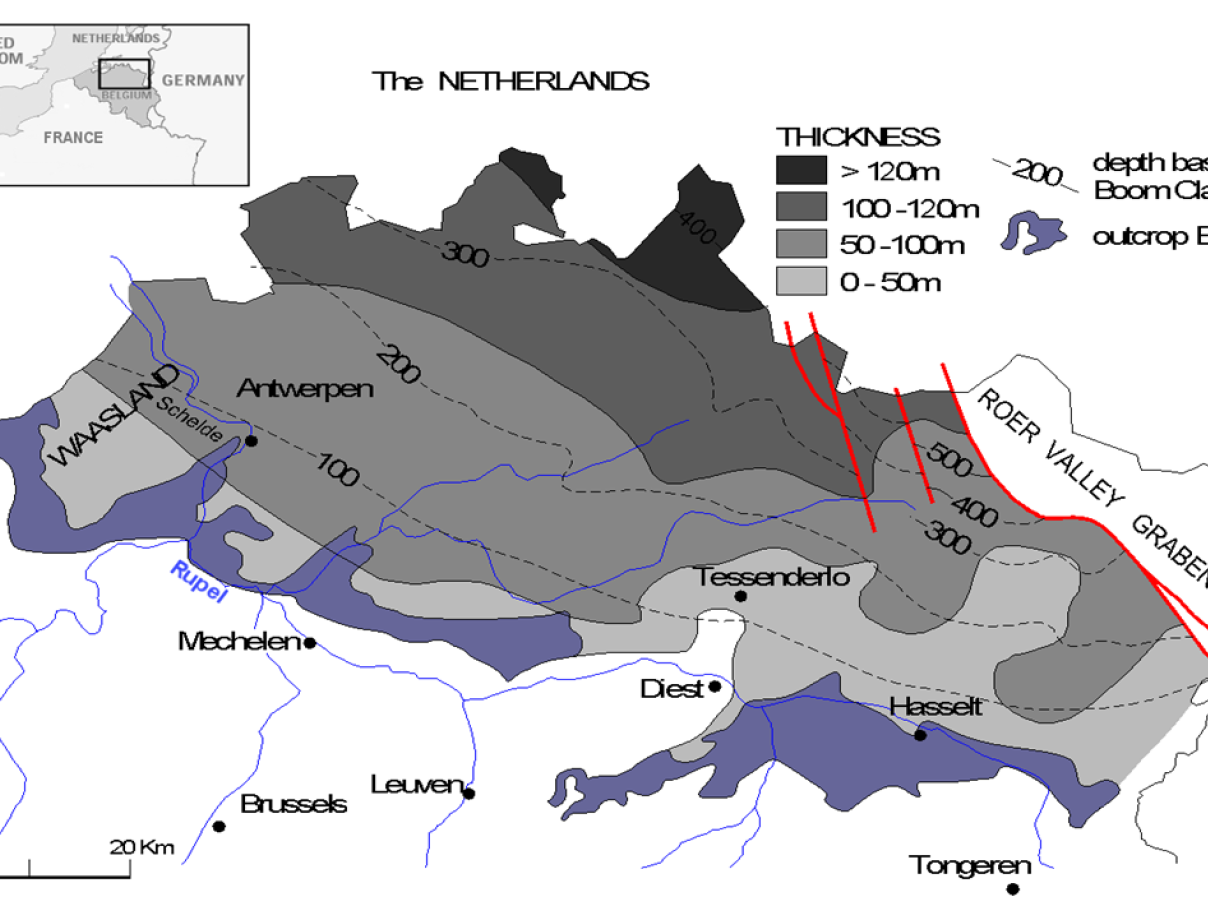
Boom Clay is found mainly in northern Belgium, dipping gently towards the northeast, where its top lies at depths of 200–300 meters. It is about 100 to 150 meters thick and consists of silty clay and clayey silt with minerals like illite, smectite, kaolinite, quartz, and feldspar. Its low permeability and plasticity make it an excellent candidate for deep geological disposal of radioactive waste, as it can slow down water movement and retain contaminants.
Scientists study Boom Clay extensively to understand its geochemical, mechanical, and hydrogeological properties, ensuring safe long-term disposal of radioactive waste.
FFiinndd oouutt mmoorree aabboouutt wwhheerree HHAADDEESS iiss llooccaatteedd
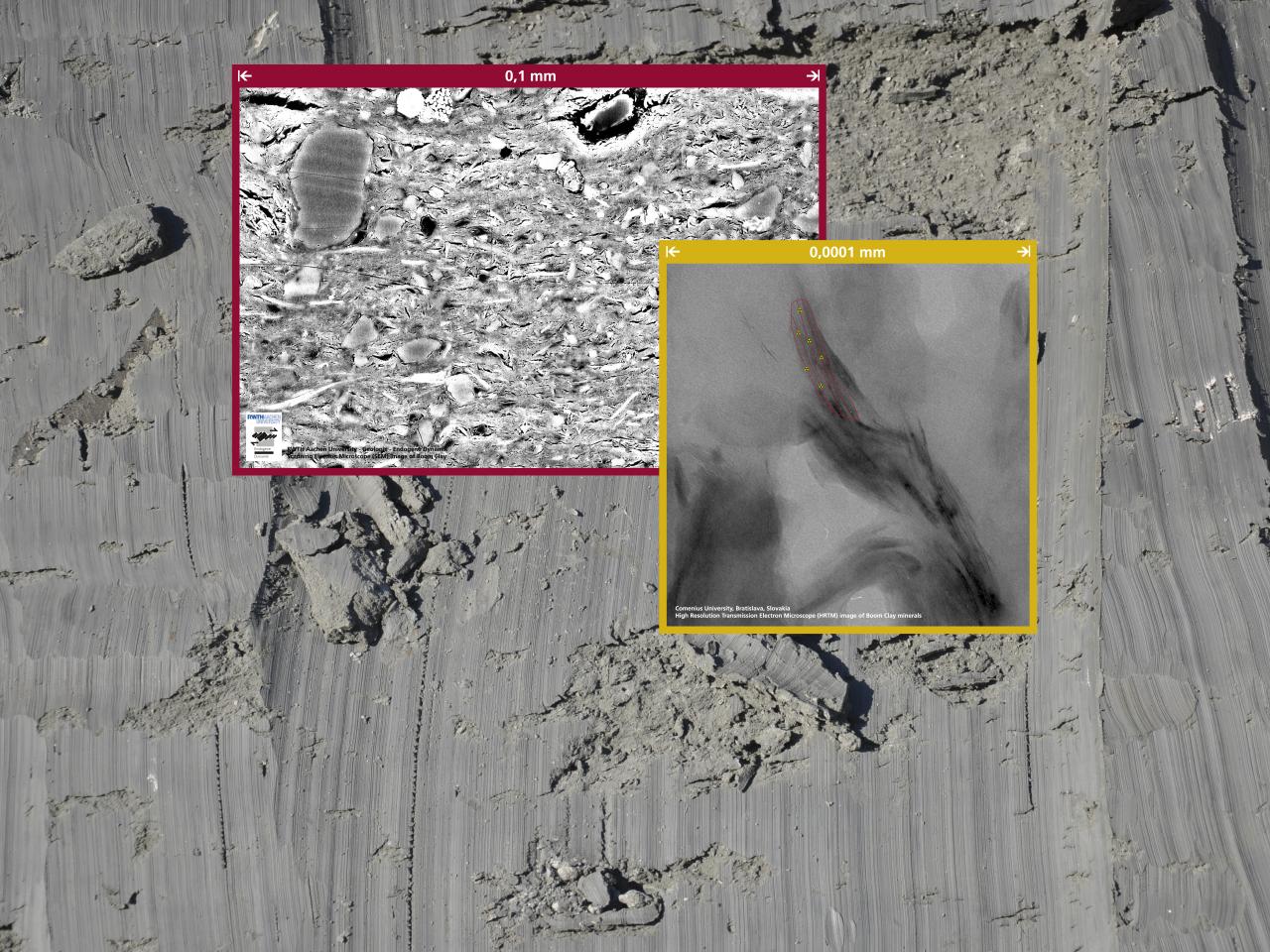
Boom Clay close-up
Zooming in on the Boom Clay, reveals its layered structure. Indeed, clay particles consist of stacked platelets. In between these platelets, positively charged elements reside. These narrow spaces will retain certain important radionuclides, as they leach from their waste packages and the disposal facility over the course of hundreds of thousands of years. This will slow down the diffusion of these radionuclides even more, given that any movement of water-soluble substances is already very slow through the clay.
Want to know more about the Boom Clay? An extensive review on this formation is available online.