The Experiments in HADES
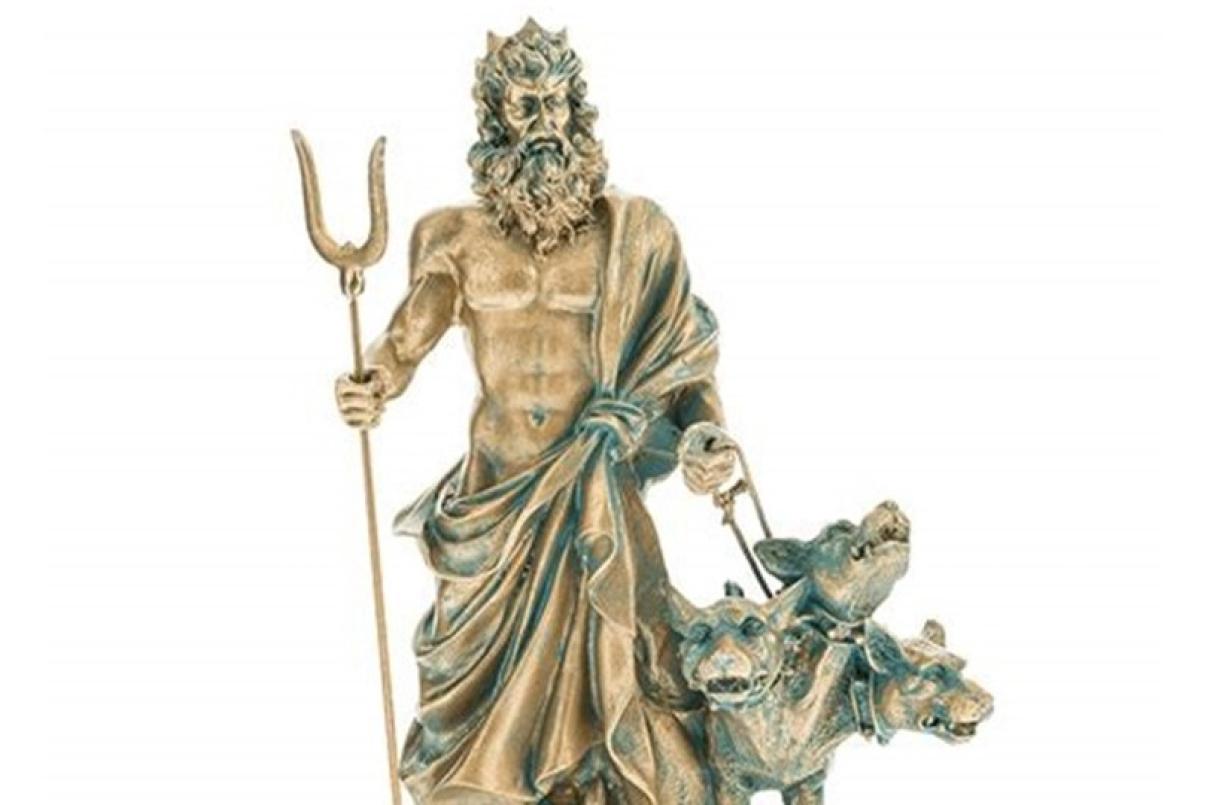
The complete list of experiments, both finished and ongoing, can be consulted here. Most experiments are in situ demonstration tests of phenomena that have already been studied at lab-scale, often in the SCK CEN laboratories. They are indispensable to draw up the safety case of the deep disposal facility in a clay environment. Many of these experiments are named after Greek mythological figures, with the occasional Roman intruder, marking not only the consistency of the researchers but also their sense of humour and creativity. In HADES, scientific excellence and the perfect backronym go hand in hand.
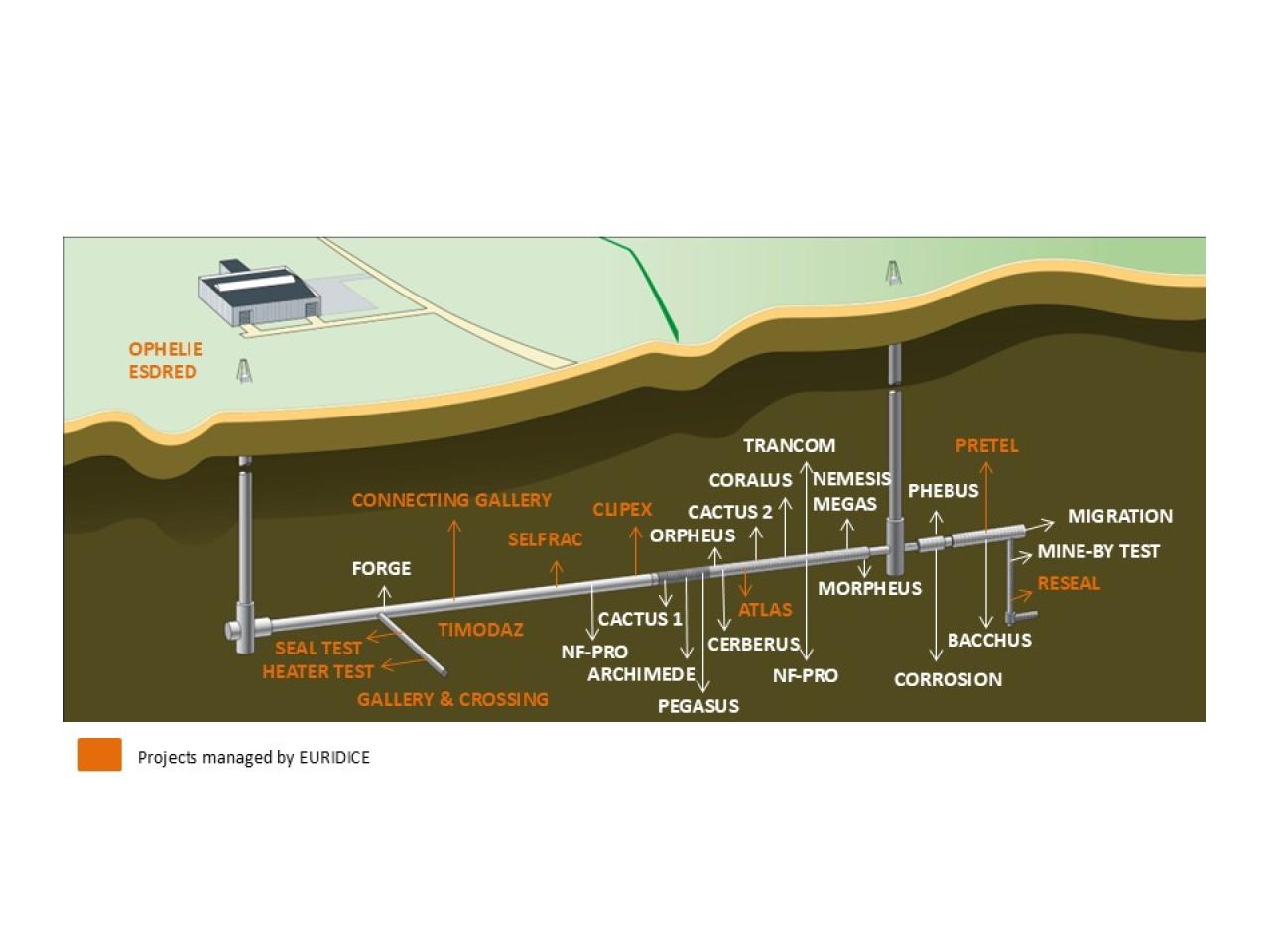
List of experiments in the HADES underground research lab
-
Stands for
Acquisition et Régulation de la CHIMie de l'Eau dans un environnement argileux
Ran from
1991 to 1995
Main topic
Study of pore water chemistry of Boom Clay, focusing on:
- Fluid and solid sampling with in situ measurements
- Fluid and solid analysis
- Microbial investigations
- Fluid-rock equilibria modelling
Partners
International project with EU support, coordinated by ANDRA (France) in collaboration with SCK CEN, BRGM, CEA and GRAM SA, with help from CNRS Laboratories and the Britisch Geological survey.
-
Stands for
Admissible Thermal Loading for Argillaceous Storage
Ran from
1992 to 2012, over phases I, II, III and IV
Main topic
Small-scale study of heat-impact on the thermo-hydro-mechanical properties of Boom Clay. It was initially set up to study the in situ effects of thermal load on the THM behaviour of Boom Clay at small scale. Later, it was used to prepare for the PRACLAY large scale in situ heater test.
Partners
Installed by SCK CEN withing the framework of the European project Interclay II which ran from 1990 to 1994. Later operated by EURIDICE in close collaboration with NIRAS/ONDRAF and SCK CEN.
-
Stands for
BACkfill Control experiment with Hydration for the Underground Storage of radioactive waste
Ran from
1988 to 1995
Main topic
- Optimization and demonstration of installation procedure for a clay-based backfill material.
- Study the hydration process of backfill material and its hydro-mechnanical interaction with the Boom Clay
Partners
The BACCHUS experiment was installed by SCK CEN, it was a partnership between ENRESA/CIEMAT and ANDRA/CEA (France) and SCK CEN, with financial support of NIRAS/ONDRAF and co-funding from the European commission (European Atomic Energy Community).
-
Stands for
ChAracterization of Clay under Thermal Loading in Underground Storage
Ran from
1989 to 1994
Main topic
study the thermo-hydro-mechanical behaviour of clay in the near field of a heating source, simulating the thermal release of 50 years aged COGEMA vitrified HLW
Partners
The CACTUS project was developed by ANDRA (France) and installed by SCK CEN, with financial support of the European Commission.
-
Stands for
Control Experiment with Radiation for the BElgian Repository for Underground Storage of heat-emitting radioactive waste
Ran from
1985 to 1999
Main topic
Demonstration of combined effects of radiation, heat, and drilling on Boom Clay properties in the near field to highly active waste, in particular in the presence of a COGEMA/AREVA/ORANO high-level waste canister after 50 years of cooling time. These effects were simulated using a 60Co-source of 400 TBq and 2 electrical heaters. The maximum temperatures reached during the test were:
- 120 °C in contact with the canister wall at the mid height of the heaters.
- 106 °C in contact with the canister wall at the mid height of the 60Co-sources.
- 50 °C at 1 m distance from the axis of the canister and at the mid height of the 60Co sources.
No strong mineralogical effects on the clay or influence on the mechanical strength were observed, the power water pressures were influenced by the heating.
Partners
CERBERUS was installed by SCK CEN, in collaboration with CEA (France). Funding was by NIRAS/ONDRAF and the European Commission.
-
Stands for
CLay Instrumentation Programme for the EXtension of an underground research laboratory
Ran from
1997 to 2003
Main topic
Monitoring the hydro-mechanical response of the Boom Clay to the excavation of the connecting gallery. This experiment was set up during the excavation of the connecting gallery, from the existing test drift into the Boom Clay in the direction of where the connecting gallery was excavated, and from shaft 2 once it was excavated. Boreholes were installed with various sensors to follow up displacement, changes in total pressure and water pressure.
Partners
The project was set up and funded by NIRAS/ONDRAF, in collaboration with the SCK CEN and EURIDICE.
-
Stands for
CORrosion of alpha Active gLass in Underground Storage conditions
Ran from
1998 to present
Main topic
Study the combined effects of radiation, heat and interacting medium on son68 high-level waste glass behaviour, radionuclide leaching and migration in underground disposal conditions. Three test tubes were installed and sampled over the years to assess the effect on the glass and clay. There is still one test tube left, to be sampled in the near future when the experiment will be finished.
Partners
The project was set up and funded by NIRAS/ONDRAF, in collaboration with the SCK CEN and EURIDICE.
-
Stands for
In-situ corrosion experiments
Ran from
1985 to 1997
Main topic
Evaluate the corrosion behaviour of potential overpack/waste materials and predict the long-term corrosion behaviour (up to 1000 years) through medium term interactions (up to 7,5 years). Various materials such as carbon steel, stainless steel and alloys of nickel and titanium were tested in direct contact with the Boom Clay at various temperatures. Since then, the Belgian disposal concept has shifted towards a concrete-based system, in which the metallic materials will not be in direct contact with the clay.
Partners
This SCK CEN project received funding from the European Commission
-
Stands for
Fate Of Repository Gases
Ran from
2011 to present
Main topic
Forge was a EURATOM 7th framework programme project. In its framework, an in situ mega packer experiment was installed in HADES, opposite the PRACLAY gallery, in June 2011. The packer system consists of two inflatable packers and is fully instrumented to perform large-scale in-situ gas experiments. The objective of these experiments is to study the role played by the excavated disturbed zone (EDZ), the interface host rock/engineered barrier system (EBS) and the host formation on the release of gas overpressure and radionuclide (RN) transport in the Boom Clay.
Partners
FORGE was a pan-European project funded by EURATOM 7 (European Commission). It was an SCK CEN project, partners were EURIDICE and NIRAS/ONDRAF.
-
Stands for
Modelling and Experiment on GAS migration in repository host rocks
Ran from
1992 to 1998
Main topic
Provide experimental data for the validation of the gas migration models and in-situ research of the long term gas migration. Helium and HTO was injected into the Boom Clay, the self-sealing capacity of the clay after a gas breakthrough was studied.
Partners
MEGAS was an SCK CEN project, funding by the European Commission was received.
-
Stands for
Four separate in situ demonstration migration experiments.
Ran from
- 134Cs migration percolation: 1987 to 1994
- HTO CPP1: 1985 to present
- TRIBICARB: 1995 to present
- TRANCOM: 1997 to present
Main topic
In situ migration experiments conducted at the HADES have provided valuable insights into radionuclide transport within the Boom Clay formation. Using a range of radiotracers, both small-scale and large-scale tests were performed to simulate laboratory conditions and assess tracer behaviour. Strongly retarded tracers such as strontium and caesium showed transport consistent with classical diffusion-retardation models, with in situ diffusion coefficients closely matching laboratory values. Larger-scale experiments with non-retarded or slightly retarded tracers (HTO, iodide, and H¹⁴CO₃⁻) confirmed the reliability of performance assessment models, with blind predictions aligning well with observed data and further validated through analytical and numerical fitting techniques.
Partners
The migration experiments were conducted by SCK CEN, follow-up is in close cooperation with EURIDICE, all work is performed in close co-operation with and with financial support of NIRAS/ONDRAF.
-
Stands for
Testing the effect of mining (gallery and shaft excavation) on unfrozen Boom Clay
Ran in
1984 and 1987
Main goal
Demonstration of tunnelling techniques in non-frozen clay and monitoring of the hydro-mechanical effect of excavation on Boom Clay. During the construction of the experimental shaft and gallery in unfrozen clay, and the construction of the test drift and Andra gallery, the surrounding Boom Clay was first instrumented with DISTOFORS to measure displacement due to the excavation. This showed the feasibility of constructing in unfrozen clay and gathered valuable in-situ data.
Partners
SCK CEN performed this research and received funding from the European commission.
-
Stands for
Mobile ORganic matter and Pore water extraction in the Hades Experimental Underground Site
Ran from
2001 to present
Main topic
Research on any variability in pore water chemistry of Boom Clay, with special attention for the organic matter content. In May 2001, 40 m non-metallic piezometer with sumatherm filters was installed, vertically from the bottom of the test drift downward. The pore water chemistry and dissolved organic matter has been characterized in 2002. Sampling of pore water is continuously ongoing in this piezometer.
Partners
The morpheus piezometer was installed by EURIDICE and SCK CEN, all work is performed in close co-operation with and with financial support of NIRAS/ONDRAF.
-
Stands for
NEon diffusion in MEgaS In Situ
Runs from
2020 to 2030
Main topic
In geological disposal sites, corrosion of metal waste components generates gas, which initially moves slowly through clay via dissolution and diffusion. If gas production exceeds the clay’s transport capacity, pressure can build up, potentially compromising the clay’s barrier function. To assess this risk, it's essential to understand both gas generation and diffusion behavior. Since 2009, SCK CEN has built a robust dataset of gas diffusion coefficients from small-scale clay samples. To validate these lab results at repository scale, the NEMESIS experiment investigates neon gas diffusion over distances greater than one metre and in multiple directions using the historic MEGAS setup. This allows researchers to confirm the relevance of laboratory data under realistic geological conditions.
Partners
The NEMESIS project is a collaboration between NIRAS/ONDRAF, EURIDICE and SCK CEN.
-
Stands for
Near Field PROcesses (oxidation)
Ran from
2004 to 2007
Main topic
The NF-PRO experiment investigates how oxidation affects the properties of Boom Clay, a formation that has remained oxygen-free since its marine deposition 30 million years ago. Excavation of galleries at the HADES Underground Research Laboratory introduces oxygen, triggering oxidation of pyrite and organic matter, which alters pore water chemistry and may influence processes such as radionuclide behavior, concrete aging, and metal corrosion. Specially designed piezometers and the use of nitrogen allowed researchers to observe oxidation effects without interference from drilling, revealing an oxidation front extending about one meter from gallery walls. High sulphate and cation concentrations confirmed pyrite oxidation, and consistent results across galleries of different ages enabled the development of a conceptual model describing oxidation around excavated zones in Boom Clay.
Partners
The project was executed by SCK CEN in close collaboration with EURIDICE and NIRAS/ONDRAF and with the financial support of the latter. The project was co-funded by the European Commission under the Euratom Research and Training Programme on Nuclear Energy within the Sixth Framework Programme (2002-2006)
-
Stands for
Oxidation Reduction Potential and pH Experimental Underground Station
Ran from
2000 to 2001
Main topic
The ORPHEUS experiment measured and monitored the redox potential and acidity of the Boom Clay Formation. In November 2000, a non-metallic piezometer was installed with different filter materials, followed by the installation of an anaerobic anaerobic infrastructure with a non-metallic flow-through cell for redox potential measurements. Sequential measurements and water samplings were performed and evaluated.
Partners
The project was executed by SCK CEN in close collaboration with NIRAS/ONDRAF and with the financial support of the latter.
-
Stands for
Partial pressure Evolution of dissolved GASes in real Underground Situations
Runs since
2004
Main topic
The PEGASUS experiment focuses on accurately measuring the in situ partial pressure of CO₂ in Boom Clay pore water, a key parameter for geochemical modelling. Using a specially designed setup that enables gas-liquid equilibrium under undisturbed conditions, researchers introduce inert argon gas to extract and analyse volatile compounds via mass spectrometry. Results show detectable levels of CO₂, CH₄, and N₂, with simultaneous measurements of pH, dissolved oxygen, electrical conductivity, redox potential, and temperature enhancing data reliability.
Partners
The project was executed by SCK CEN in close collaboration with NIRAS/ONDRAF and with the financial support of the latter.
-
Stands for
PHEnomenology of hydrological transfer Between atmosphere and Underground Storage
Ran from
1991 to 1995
Main topic
PHEBUS studied the hydraulic and hydromechanical behaviour of Boom Clay, such as its desaturation, around a ventilated gallery, the first gallery. Three instrumented boreholes were installed in 1993, a central probe with dry air circulation was installed in 1994. Total and pore water pressure and water content variation in the clay were followed up. The experiment showed that the desaturation zone in the clay massive is limited in the ventilation phase.
Partners
The project was performed by SCK CEN.
-
Stands for
Preliminary demonstration tests for clay disposal
Runs from
2007 to 2030
Main topic
The PRACLAY experiment is the largest experiments that is currently running in HADES. It is of crucial importance to our THM knowledge. Because of its many aspects and great importance, a separate web page is dedicated to PRACLAY.
-
Stands for
PRE - TEnsioned Lining
Ran from
1994 to 2004
Main topic
While traditional disposal galleries for radioactive waste typically measure around 2 metres in diameter, smaller-diameter galleries offer compelling advantages—such as reduced excavation and backfill volumes, and less disturbance to the surrounding host rock. However, installing lining in these narrow tunnels presents technical challenges, especially at depths beyond 200 metres in clay formations. The commonly used pipe-jacking method becomes impractical for galleries longer than 30 metres due to excessive friction. The PRETEL project investigated this by testing a micro-tunnelling technique as an alternative to the large diameter concept.
Partners
PRETEL was an SCK CEN R&D project, SMET Boring was the industrial partner.
-
Stands for
Sealing off a borehole
Ran from
1997 to 2004
Main topic
A large-scale in situ demonstration test for repository sealing in an argillaceous host rock. An existing borehole in the test drift was sealed off with bentonite and its effectiveness was followed up by instrumentation over time.
One of the challenges for long-term safety is backfilling and sealing shafts and galleries. This is needed to avoid preferential pathways for water, gas and radionuclide migration. The demonstration of the feasibility of sealing on a representative scale is therefore essential. The applicability of highly compacted bentonite for this purpose has been investigated. The low permeability, swelling capacity and high sorption capacity of bentonite make it a very effective barrier
Partners
EURIDICE, SCK CEN and NIRAS/ONDRAF
-
Stands for
Sealing off a shaft
Ran from
1997 to 2009
Main topic
A large-scale in situ demonstration test for repository sealing in an argillaceous host rock. The experimental shaft was sealed with bentonite and its effectiveness was followed up by instrumentation over time.
One of the challenges for long-term safety is backfilling and sealing shafts and galleries. This is needed to avoid preferential pathways for water, gas and radionuclide migration. The demonstration of the feasibility of sealing on a representative scale is therefore essential. The applicability of highly compacted bentonite for this purpose has been investigated. The low permeability, swelling capacity and high sorption capacity of bentonite make it a very effective barrier.
Partners
EURIDICE
-
Stands for
SELF-Healing and FRACtures within the Excavation Disturbed Zone
Ran from
2001 to 2004
Main topic
SELFRAC aimed to characterize the EDZ and its evolution with time in plastic and indurated clays. The perturbation of the excavation could lead to a significant increase of the permeability related to diffuse and/or localized crack proliferation in the material. However an opposite process, which involves the sealing and healing properties of clays can in turn reduce the permeability in time. The main objective of the project was to understand and to quantify these processes and to assess their impact on the performance of radioactive waste geological repositories. Laboratory and in situ tests to characterize the fracturing and the sealing processes were performed within the SELFRAC project. The experimental results were compared with the numerical simulations.
Partners
The project was coordinated by EURIDICE. It was a joint project with NAGRA (Switzerland), Laboratoire 3S (France), LMS-G3S (France), K.U.Leuven (Belgium), EPFL (Switzerland) and SOLEXPERTS (Switzerland).